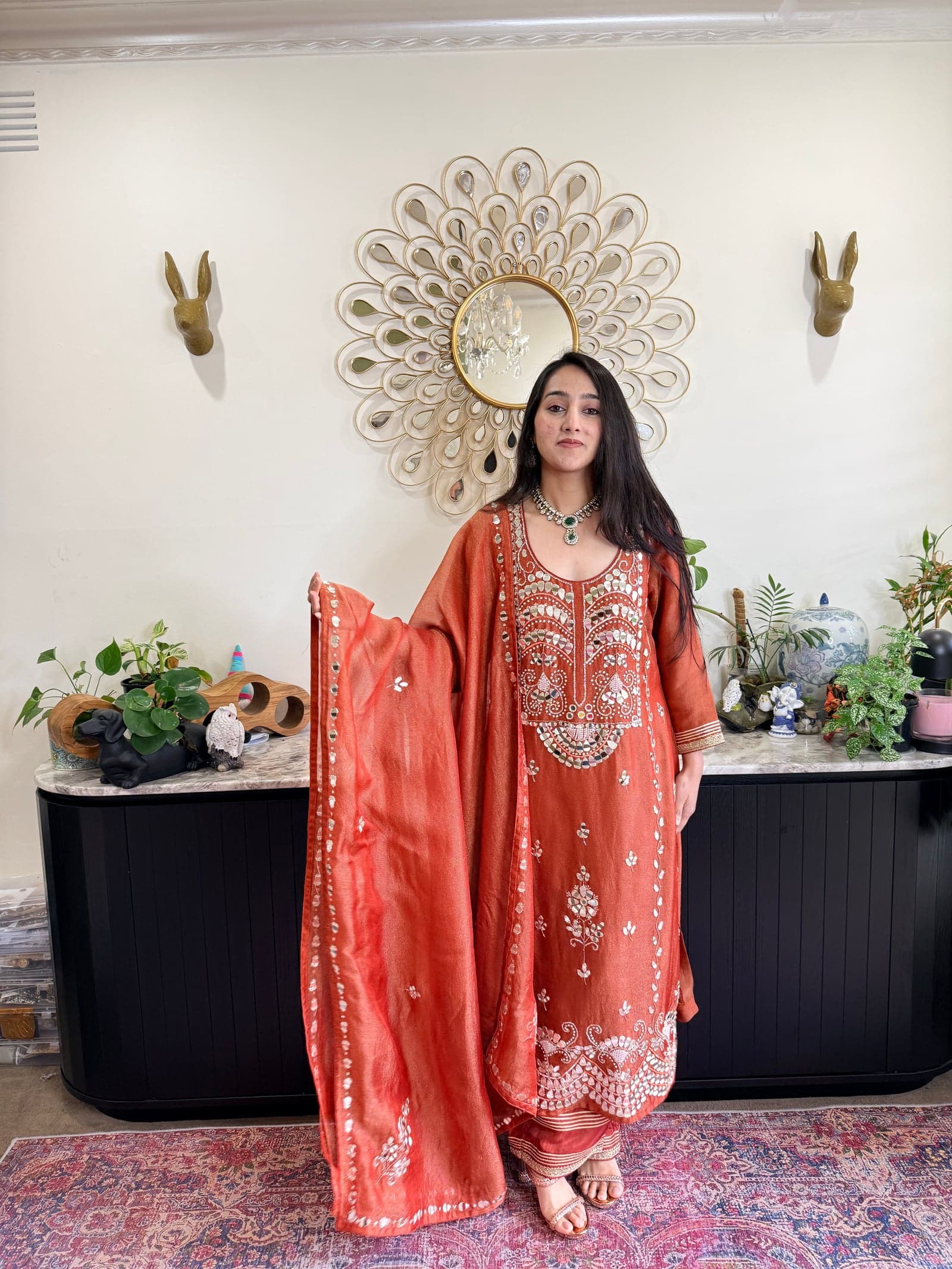
I have spent the festive season in Melbourne for eleven years now, and I still do not pack a wardrobe in March the way I packed one when I was leaving Bombay in October as a girl. The festival is the same. The grammar around it is different. The light is drier in Melbourne, the evenings stretch longer through November, the puja sits inside a Saturday brunch instead of at the head of a Karol Bagh street, and the heat — when it lands — is the bright glassy heat of an Australian late spring, not the soft thick heat that hangs over a Mumbai October. The wardrobe should know.
Begin with the light. A festive evening in Mumbai or Delhi is lit, mostly, by fairy lights and earthen diyas at low angles and the sodium glow of street lamps. The cloth that flatters in that light is deep — bottle green, deep magenta, oxblood, navy — because those colours absorb the warm yellow ground and return it as depth. The same cloth, photographed at a Bondi brunch on a 24-degree November Sunday under a clean southern sky, can read as heavy and a little funereal. The Melbourne palette runs lighter and more saturated. The Banarasi I would wear to a Mumbai sangeet in October would not be the Banarasi I would wear to an outdoor reception in Centennial Park on the second weekend of the festival here. The first wants depth. The second wants light.
Then there is the heat. A Mumbai festive season is a humid, breathable heat that asks for silk that drapes wet. A Melbourne festive season is drier and harder on a heavy silk pleat — the cloth holds its shape, but the body underneath it wants air. We cut the linings differently for here. Cotton lawn, not poly. Half-linings where the cluster allows. A pre-draped saree fall built on a lighter petticoat. The chikankari kurtas we send into Melbourne in October are deliberately one weight finer than the same piece for a Delhi customer, and the difference is visible at the underarm before it is visible anywhere else.
The calendar moves too. A Bombay festive week is, traditionally, five evenings in a row — Dhanteras, Naraka Chaturdashi, Lakshmi Puja, Govardhan, Bhai Dooj — and the wardrobe rotates across all five. A Melbourne festive week is, in practice, three weekends of brunches, one office-festive function on a Thursday evening, and one puja at someone's house in Wentworthville on the Saturday night. The wardrobe does not need five distinct outfits. It needs three pieces that travel well across registers — a daytime silk that can sit at brunch, a festive set that can move from puja to dinner, and a heavier piece for the office function or the Saturday house party. We are increasingly designing the festive capsule around that three-piece rhythm rather than the five-evening one.