Loading the atelier…
Technique · Hyderabad / Delhi (Mughal lineage)
Zardozi.
ज़रदोज़ी
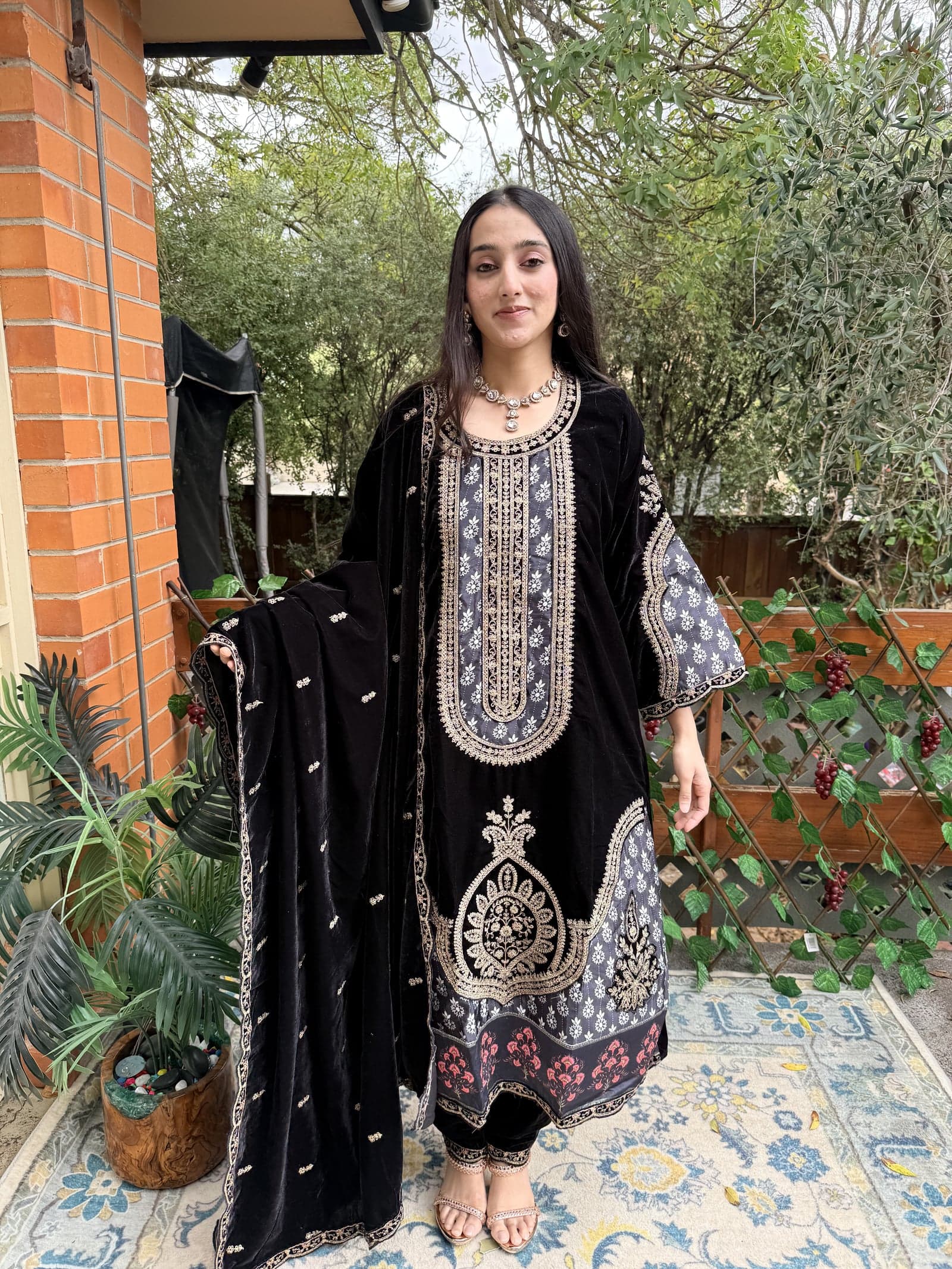
A Mughal court embroidery that travelled south with the Nizams and stayed — worked on a wooden adda frame, with hooked aari needle, beads, and real metallic thread.
Zardozi is the heaviest of the embroideries we work in. A panel is stretched onto the adda — a low wooden frame, sometimes six feet long — and three or four karigars sit around it, each working a section, threading aari needles with kalabattu and pulling salma coils into place by feel as much as by sight. The work proceeds from the outside in, motif by motif, and a single sleeve panel of dense zardozi can take a four-karigar table a fortnight.
The Mughal court paid for zardozi in silver by weight, and the convention persists in the trade: real zardozi is still priced on a per-gram basis for the metal alone, with the karigar's labour on top. We buy kalabattu from a single supplier in Delhi who can prove the silver content, because the market is full of polyester-coated wire passing as the real thing — it photographs the same on Instagram and tarnishes in eighteen months. Real metal blackens slowly and can be re-burnished by a specialist; the fake stuff simply dies.
What you should know as the wearer: zardozi is structural. The cloth underneath has to carry the weight, which is why we work it on velvet, silk dupion, or heavy satin and never on chiffon or georgette regardless of the trend. The piece should be stored flat with acid-free tissue between the embroidered surfaces. And the karigar who worked the central motif of your piece will be named on the atelier file you receive at delivery — because zardozi is too slow and too costly to ship anonymously, and anonymity is the first thing that goes wrong.
Vocabulary
The terms.
- adda
- the wooden floor-frame that holds the cloth drum-tight while the karigar works from above
- aari
- the hooked needle, held in the right hand, that catches thread fed from below the cloth
- kalabattu
- the fine metallic thread itself — silver or gold-gilt over silk core
- salma
- tight metallic coil cut into short lengths and stitched down like a bead
- sitara
- small metallic spangle, used to catch light at high points of the motif
“The court paid for it in silver by weight. The convention persists.”
— From the atelier file, Hyderabad / Delhi (Mughal lineage)