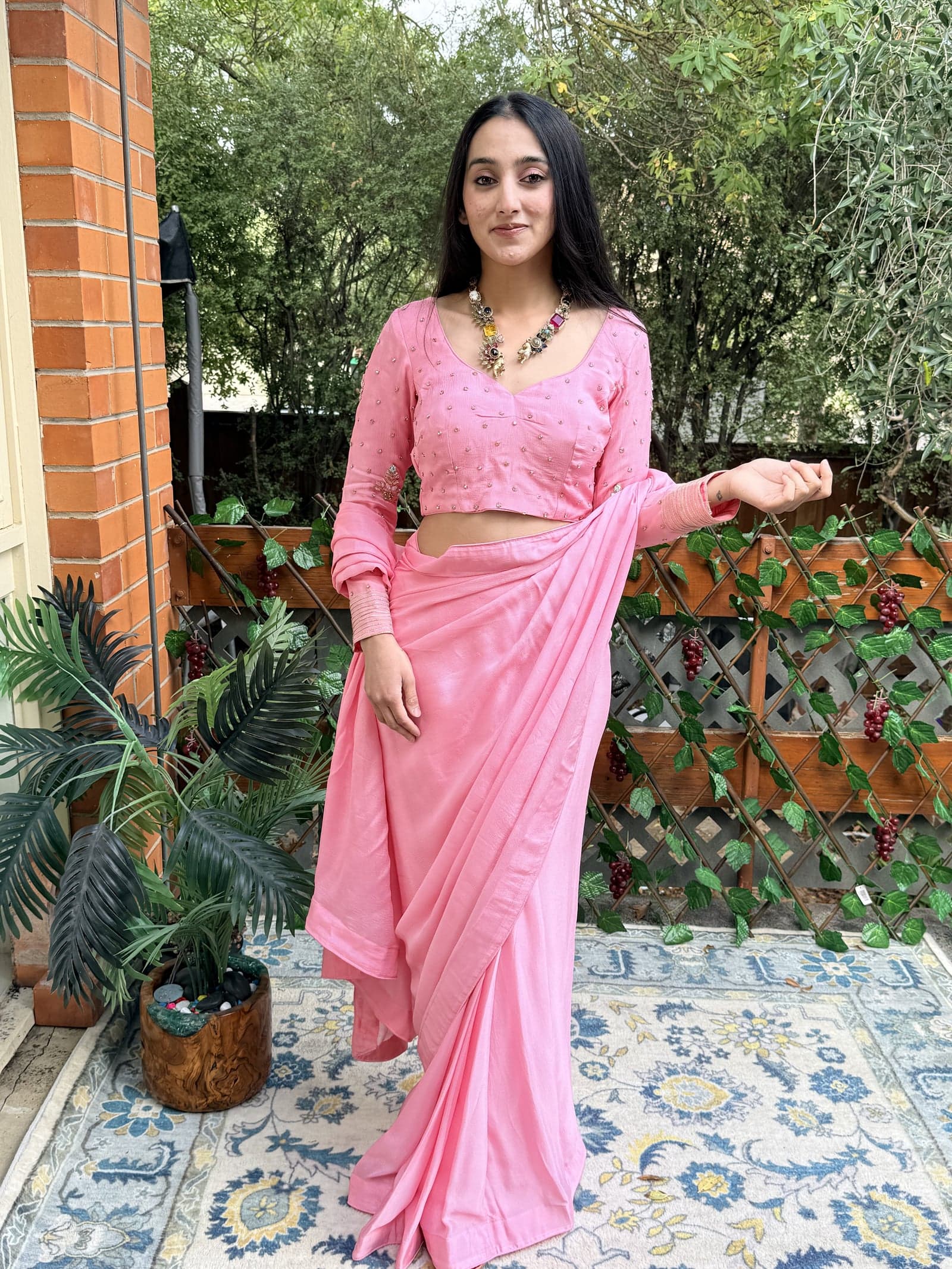
I named her, and then I named her atelier — and I want to tell you, honestly, why I did it in that order. Aratrikkaz is for Aratrikka. The name on the door is the name on her birth certificate. I have heard, more than once, that this is a sentimental thing to do with a fashion house. I have decided to keep being sentimental about it.
The moment of the name itself was very quiet. Aratrikka was a few weeks old. It was the small hour after a feed when the house is asleep and the only light is the one above the kitchen sink. I was holding her, and I had a notebook open on the counter — I had been keeping a list of words for a year, the way some women keep a list of names. Most of the words on that list were Sanskrit, some were place-names, some were the names of weaves. None of them were hers. I closed the notebook. I wrote her name at the top of a clean page. And underneath, without thinking about it very hard, I wrote: Aratrikkaz. The “-z” was already there. I had not planned it. I had simply ended her name with the small sound that, to me, has always meant “and those who belong to her”. The plural. The inheritance. The everyone-else.
Twenty years before that night, I was already standing in workshops. I was nineteen the first time a master weaver in Banaras let me touch a kadhua butti before he had finished it — the silk still warm from his hands, the silver-gilt zari sitting just proud of the ground weave. He did not tell me it was beautiful. He told me how many hours it had cost him. That is the conversation I have been having, in one form or another, ever since. With Lucknow chikan-workers who sew by lamplight. With bandhani women in Kutch who tie ten thousand knots before the cloth ever meets dye. With a pattern-master in Melbourne who can read an Australian body the way the weavers read a loom-card. The craft did not arrive with the atelier. The craft arrived first, and I followed it for twenty years before I dared to put a name on what I was doing.
People have asked, kindly and otherwise, why the spelling sits the way it does. Why “Aratrikkaz” and not “Aratrika” or “Aratrikha”. The honest answer is that the “-z” is a small piece of diaspora grammar. It is the way her name will be pluralised in an Australian classroom — “the Aratrikkaz”, the other girls who share her seat, her city, her wardrobe. It is also the small marker that this is not only her atelier; it is all of theirs. The “-kk-” doubles because the Devanagari अरात्रिक्काज़ doubles in the mouth, and I refused to soften the sound for an English keyboard. The wordmark holds its accent the way she will hold hers.
We carry the name in both scripts. अरात्रिक्काज़ on one line, Aratrikkaz on the next. I think about this a great deal, because I think about what she will see when she is old enough to read what is above the door. She will see the script her grandmother reads, and the script her teacher reads, sitting one above the other without one having to apologise for the other. That is the whole brand, in two lines. That is what I want every daughter who walks into one of our pieces to feel: that both of her languages are already on the label, already dignified, already the same size on the page.